
That question is getting harder as AI moves beyond experimentation. Deloitte’s 2026 State of AI survey found that only 25% of companies had moved at least 40% of their AI pilots into production, while 54% expected to reach that level within the next three to six months.
A large company can end up with dozens or even hundreds of AI projects across marketing, finance, customer service, software development, operations, and HR. Each may have a reasonable business case. The problem arises when they compete for the same budget or rely on the same data and infrastructure.
Companies are responding by placing AI higher up the organizational chart. IBM’s 2026 CEO study found that 76% of surveyed organizations now have a Chief AI Officer, up from 26% a year earlier.
Ernst & Young (EY) has just created an AI Value Realization Office to centralize its AI investments, monitor returns, determine which initiatives to scale, and oversee AI’s impact across the organization. EY says its research shows that 75% of AI’s potential enterprise value comes from cross-functional activities.
AI is becoming important enough that some companies are building dedicated mechanisms to determine where it belongs on the balance sheet.
The next step is to form an AI investment committee.
What Is an AI Investment Committee?
I see an AI investment committee as a senior, cross-functional group that decides how a company allocates capital and resources to AI.
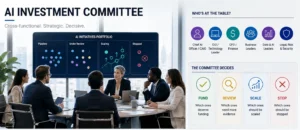
It would bring together people who view the issue from different angles. They can include the Chief AI Officer or CIO, CFO, business leaders, data and technology executives, and people from legal, risk, and security.
The purpose of the committee would be to look over the company’s AI initiatives and decide:
- Which ones deserve funding
- Which ones need more evidence
- Which should be scaled
- Which should be stopped
This may sound like an ordinary capital-allocation committee. The difference is that AI projects can affect almost every part of the business at once.
For example, a software development tool may look like a productivity purchase to one department, but it can become a major enterprise technology decision once thousands of employees use it. That is why I think a separate decision-making forum can make sense.
The emergence of the Chief AI Officer points in the same direction. IBM found that organizations with a Chief AI Officer (CAIO) reported a 5% higher return on their AI investment. However, that figure shows an association, not causation, so it doesn’t prove that the role itself caused the improvement.
The CAIO can provide leadership and coordination. An investment committee gives the broader business a forum for making trade-offs.
It’s Already Starting to Show Up
This isn’t just theoretical anymore. In late July 2026, AI Health Technology Limited, a Hong Kong-listed firm, formed a new investment committee. Their sole explicit job is to centralize and govern the company’s AI spending. A chairman and two independent directors lead it, and the company published formal terms of reference alongside the appointment.
A 2025 EY survey found that about half of Fortune 100 companies now voluntarily disclose that AI risk falls under formal board oversight, nearly triple the share that said so the year before.
Separately, three in four boards have approved major AI investments this year, according to Grant Thornton’s 2026 AI Impact Survey. Still, fewer than half have set governance expectations for that spending, and fewer than half have made AI risk a standing agenda item for the board or a committee.
That gap between approving money and governing it is exactly the space an AI investment committee is designed to close.
Why AI Spending Needs a Portfolio Approach?
When several AI projects are competing for resources, I don’t think it makes much sense to judge each one in isolation.
A finance team may have a strong case for an AI forecasting system. The customer service team may have a compelling case for AI agents. Software engineering may want a much larger budget for coding tools.
All three could be worthwhile. But the company still needs to decide how much it wants to spend, what infrastructure to share, which project has the strongest strategic value, and what the organization is capable of implementing. So, the idea of an AI portfolio becomes useful here.
A committee can review the full set of projects and assess whether the balance is right. Some investments may yield productivity gains more quickly. Others may take longer but could create new products or reshape an important business process.
The committee can also ask a question that individual teams have little incentive to ask: Should we stop this? That matters because AI projects can gain momentum quickly. A successful pilot attracts users, and more money follows. By the time the promised benefits fail to appear, the project can have become difficult to challenge. A central committee provides a natural point for that review.
I found PwC’s 2026 analysis effective for understanding the uneven distribution of AI returns. Across 1,217 organizations surveyed, the top 20% captured 74% of AI-driven returns. PwC’s analysis points to governance, implementation depth, data, and technology as factors that separate the stronger performers from the rest.

That suggests a company doesn’t always gain by funding the most AI projects. It may gain by choosing the right ones and giving them enough support to succeed.
The Move From Pilots to Production Changes the Equation
A pilot is easy to approve. A team can test an AI tool with a small group, measure the results, and decide what to do next. However, production is different.
When an AI system becomes part of a real business process, the company assumes ongoing costs for infrastructure, data, security, monitoring, integration, and personnel. The system also becomes much harder to treat as a technology experiment because customers and employees may now depend on it.
The amount involved is growing even faster. KPMG’s first 2026 AI Pulse survey found that organizations expected to spend an average of $207 million on AI over the next 12 months, almost twice the amount reported in the comparable survey a year earlier.
Yet companies still have limited visibility into the actual costs of running some of these systems. KPMG’s second-quarter survey found that while 66% of organizations had monitoring dashboards and 61% had approval processes for AI, only 26% had full, real-time visibility into the cost of running AI at scale.
That raises a very different investment question. A company can approve an AI pilot based on a promising use case. When that system runs across a department or an entire organization, executives need to know whether the economics still hold.
Is the system generating enough value to justify its ongoing cost? Should the company expand it? Can two projects share the same infrastructure? When does an expensive AI application no longer make economic sense?
These decisions sit at the intersection of technology, finance, and business strategy. I think this makes the AI investment committee a practical way to manage a growing portfolio of AI spending. Plus, I think this is where many AI budgets will face much closer scrutiny.
Who Should Sit on the Committee?
I wouldn’t make this another technology committee. The whole point is to bring different forms of expertise together in the same conversation.
A CAIO or CIO would lead the technology function. The CFO should have a strong voice because AI investments entail both recurring operating costs and traditional capital spending. Business-unit leaders can explain where the commercial value lies.
Then there are the people who will challenge the proposal.
Risk, legal, security, and data leaders can identify issues that may not be evident in an investment case. HR may also need a seat at the table when an AI initiative changes roles or workforce requirements.
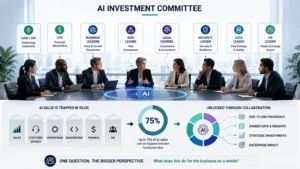
The exact structure will vary by company. What matters is that no single function gets to define AI’s value on its own. This is important because AI’s value often spans organizational boundaries.
EY-Parthenon’s research is the source of the 75% figure I mentioned earlier. Up to 75% of AI value can be trapped within functional silos when companies focus on isolated use cases. The firm argues that unlocking more value requires attention to end-to-end business processes that span departments.
An investment committee can reflect that reality. It can look beyond the question, “Does this” department benefit?” and ask, “What does this do for the business as a whole?”
What Should the Committee Actually Decide?
The committee shouldn’t become another layer of approval for every small AI purchase.
I’d give it responsibility for decisions that could materially affect the company’s strategy, spending, or risk. That could include major AI platforms, large-scale deployments, new AI products, significant infrastructure commitments, and initiatives that affect multiple functions.
For each one, the committee should have a clear view of four things:
- The expected business value
- The total cost
- The risks
- The conditions required for success
I would also want a regular review after the investment is approved. It should be built around a short set of relevant questions, such as whether the project has delivered what it promised, whether usage is actually growing, whether costs are changing, and whether the underlying business case has gotten stronger or weaker since approval. The answer to that last question should determine whether to commit more capital.
Those questions are important because AI economics are still evolving quickly. EY’s AI Value Realization Office monitors AI returns and determines which initiatives should scale. That is the same discipline an AI investment committee would bring to a broader organization.
The Governance Challenge
An AI investment committee should not become another version of the AI team. Its role is to make investment decisions, guided by clear criteria and accountability.
The board still plays an important role. PwC’s 2026 guidance argues that AI oversight should cover strategy, capital allocation, operations, and risk, with responsibilities divided between the board and management.
Companies are already building parts of this structure. For example, TransUnion has a Technology Committee overseeing technology strategy, alongside a separate Data Risk Committee that addresses risks related to data analytics, governance, and emerging technologies.
A similar division could work for AI investments. The executive AI investment committee can make operating and allocation decisions, while the board can provide oversight and challenge management to ensure those investments support the company’s strategy and risk appetite.
Bottom Line: The Committee’s Real Test Will Be Saying No
It is easy to create an AI strategy, but it is harder to decide which parts of that strategy merit the next dollar.
That is why I think the most valuable AI investment committees are those willing to reject projects with weak economics, those that duplicate existing efforts, or those that no longer fit the company’s priorities.
AI is moving deeper into production. More companies are placing dedicated AI leaders in the C-suite, and the sums involved are becoming harder to treat as experimental spending.
Someone needs to connect all those decisions. The AI investment committee could serve as that mechanism. It can act as a place where technology ambition meets financial discipline, and where companies decide