
Artificial intelligence has moved beyond being an enterprise software capability. It is now heading toward becoming part of how companies operate.
For Fortune 500 organizations, the next phase goes beyond adding copilots to employees’ workflows or launching isolated AI pilots. It is about redesigning the enterprise so that intelligence, automation, decision-making, and human expertise work together as part of the operating model.
The conversations happening inside the boardrooms of Fortune 500 companies are structural. How does a hundred-year-old organization rebuild itself so that AI becomes the operating system for the entire enterprise?
The gap between using AI and becoming an AI-native enterprise is becoming strategically important. This shift is being called “AI-native” operations, the defining transformation story in 2026. Below is a grounded look at where things stand today.
Where Fortune 500 Adoption Actually Stands
Ask ten companies whether they “use AI,” and nearly all will say yes. That question stopped being useful years ago. The more revealing question for Fortune 500 companies is how deep that usage actually goes. The following is some documented information:
- 92% of Fortune 500 companies use OpenAI’s products in some form, according to OpenAI’s own State of Enterprise AI reporting.
- About 90% of Fortune 100 engineering organizations have deployed GitHub Copilot, and there are 4.7 million paid subscribers firm-wide as of January 2026.
- Microsoft claims that 90% of the Fortune 500 use Microsoft365 Copilot, but independent trackers report paid and active deployments at about 64%. Accenture runs the largest deployment, with over 740,000 seats, yet its weekly active usage is under half of the purchased seats.
- Only 58% of companies with $5 billion+ in revenue are fully scaling AI to automate operations, meaning that even at Fortune 500 scale, “adopted” and “fully scaled” are split almost in half.
That gap between owning a license and running AI at operational scale is where most Fortune 500 stories live right now. However, they have moved beyond asking “Should we use AI?” The question now is how deeply AI can be embedded in core operations, workflows, governance, and decision-making.
What the Numbers Look Like Inside One Real Company
Let’s understand AI integration in Fortune 500 companies through a concrete case study of JPMorgan Chase. Its internal LLM Suite platform is used by about 150,000 employees every week. The bank now also runs more than 450 generative AI use cases in production, spanning customer service, software engineering, risk functions, and more, with a stated goal of reaching 1,000.
Employees using the platform estimate they save about four hours per week, though CEO Jamie Dimon has acknowledged that those time savings aren’t yet captured in the bank’s formal ROI calculations for AI projects. JPMorgan is budgeting about $19.8 billion for technology in 2026, up 10% year over year.
Other Deployments from Fortune 500 Companies
Other than JPMorgan Chase’s, there are some other companies that are sharing real usage numbers about their AI adoption/integration:
- Goldman Sachs’s GS AI Assistant reaches all 46,000 employees firm-wide.
- Bank of America’s consumer-facing assistant Erica has logged more than 3 billion cumulative interactions since 2018, averaging 58 million interactions per month.
- Financial services as a sector reports the deepest ROI realization. 89% of firms say AI has lifted revenue or cut costs, and 69% report revenue increases of 5% or more.
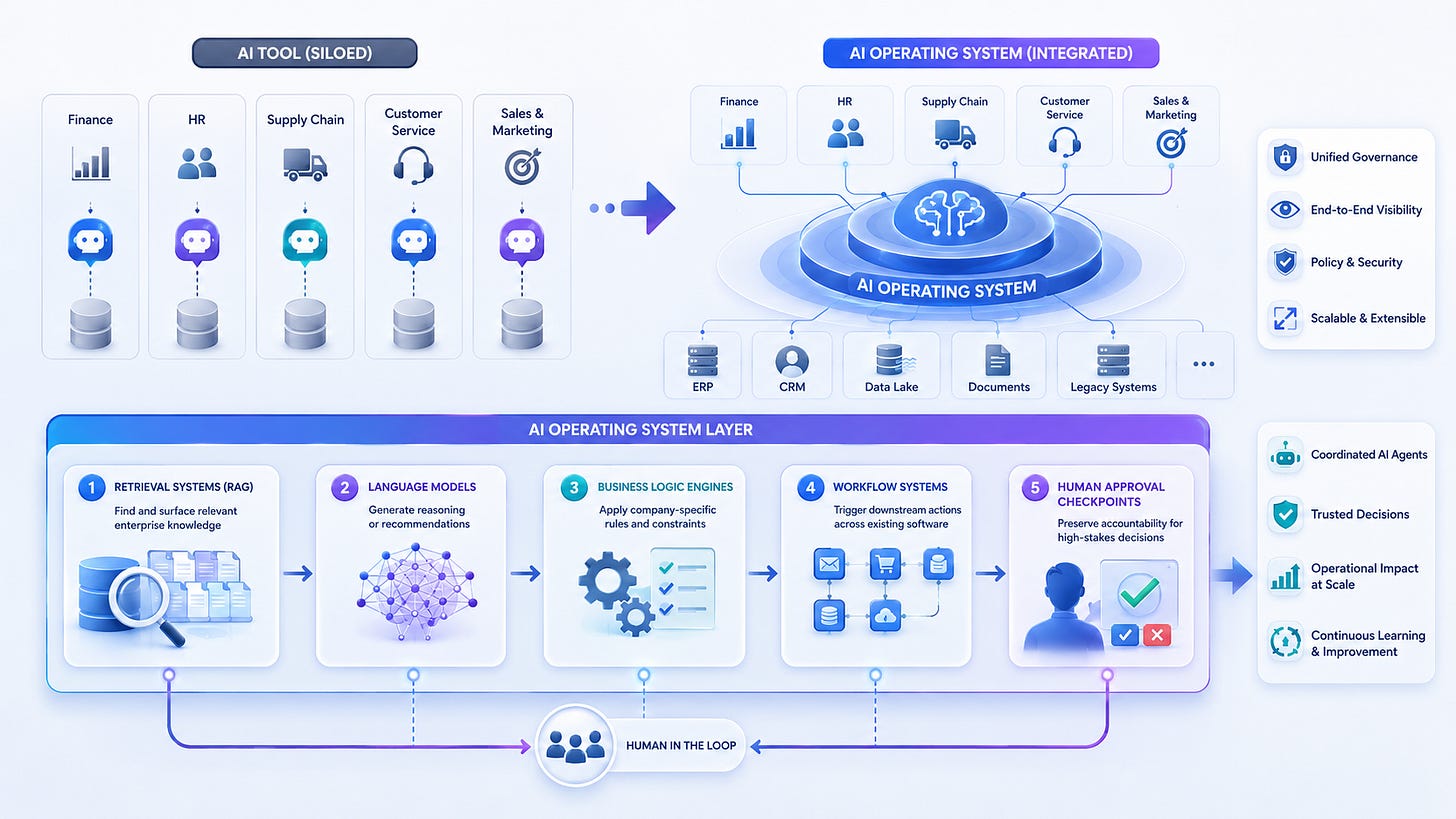
The Shift “AI Tool” to “AI Operating System”
The phrase “AI operating system” has become shorthand for a specific architectural shift occurring within large enterprises.
Organizations are now building a coordination layer that sits between enterprise systems and workflows and multiple AI models. The focus is shifting from deploying disconnected chatbots or point solutions in individual departments to building an integrated AI layer that connects enterprise data, applications, workflows, AI agents, and human decision-making across the organization.
Why Orchestration Became the Central Problem
A single AI pilot is easy to manage. Dozens of AI agents interacting across finance, HR, supply chain, and customer service at the same time is a different problem. Most current enterprise AI programs stall here.
Common failure points identified across enterprise architecture research include:
- Model Fragmentation: Different business units adopting disconnected and unmanaged AI tools.
- Workflow Breakdowns: AI outputs that never actually integrate into how work gets done.
- Governance Blind Spots: Leadership losing visibility into how automated decisions get made.
- Agent Sprawl: An unmanaged proliferation of agents with no central policy enforcement.
Gartner’s research frames agentic orchestration platforms as the “control layer” because they enable AI to scale from isolated pilots to governed and autonomous execution. Gartner logged a 1,445% surge in enterprise inquiries related to multi-agent systems during Q1 2024 and Q2 2025, signaling how fast this shift is happening.
What the Operating System Layer Actually Does
An enterprise AI operating system coordinates several distinct layers:
- Retrieval systems (RAG) that surface relevant enterprise knowledge on demand.
- Language models that generate reasoning or recommendations.
- Business logic engines that apply company-specific rules and constraints.
- Workflow systems that trigger downstream actions across existing software.
- Human approval checkpoints that preserve accountability for high-stakes decisions.
This layered design reduces the risk of hallucinations and keeps humans in the loop when regulation or risk demands it. It also lets an enterprise swap in new models without rebuilding the entire underlying stack.
The Rising Governance Gap
Deployment speed has outpaced the control infrastructure in many of these rollouts. Microsoft’s 2026 Cyber Pulse research found that over 80% of Fortune 500 firms run active AI agents, yet only 47% of organizations have dedicated security controls for generative AI. Additionally, 29% of employees admit to using unsanctioned AI agents for work tasks outside official channels.
That combination of high usage and thin governance is why Gartner projects that 40% of agentic AI projects will be canceled by 2027 because of unclear ROI, inadequate risk controls, and escalating costs.
The Operating Model Behind the AI-Native Enterprise
An AI operating system can connect the enterprise, but connections alone do not make a company AI-native. McKinsey’s research quantifies this gap. Only 21% of organizations have redesigned workflows end-to-end, even though workflow redesign is linked to AI-driven business impact.
A global survey of 750 leaders found the same pattern from a different angle. It identifies three stages of AI maturity:
- Enablement
- Automation
- Reinvention
The survey found that about 90% of organizations remain stuck in the first two stages, with only 11% reaching genuine reinvention.
So, the next step is changing the workflows, roles, decisions, and operating structures built around AI infrastructure.
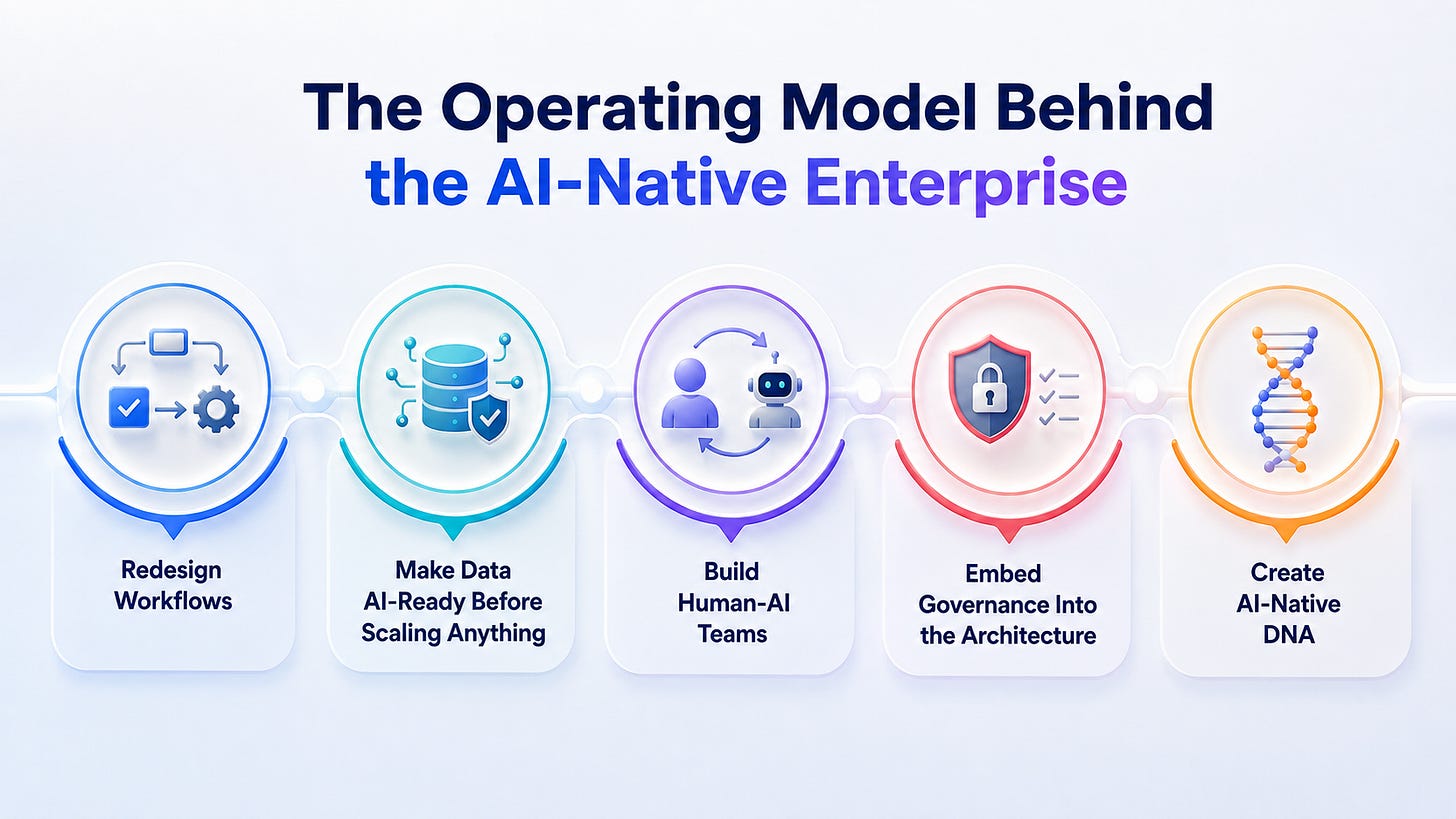
Redesign Workflows
The shift begins with redesigning end-to-end workflows. Companies should determine which activities AI can handle and where human judgment remains necessary. In addition, they must emphasize how both can work together from beginning to end.
AI delivers limited value when inserted into processes designed for a pre-AI enterprise. McKinsey reports that 84% of organizations left jobs and workflows unchanged despite a 50% increase in worker access to AI in 2025.
Make Data AI-Ready Before Scaling Anything
AI cannot operate reliably without governed access to enterprise context, and most large enterprises lag in this area. Only 7% describe their data as “completely ready for AI,” and just 15% say they are fully ready to deploy AI agents in production.
Gartner finds that 63% lack (or are unsure about) appropriate data management for AI and expects unsupported projects to be abandoned. Structured readiness outpaces unstructured by 26 points (65% vs. 39%), which is critical since most enterprise knowledge is unstructured.
Companies need governed connections among AI systems and the data held in ERP, CRM, databases, documents, and legacy platforms. This makes data quality, permissions, retrieval, and lineage integral to the AI operating model.
Build Human-AI Teams
AI-native operations do not necessarily remove people from the workflow. They divide work based on the strengths of humans and AI.
Agents can handle repetitive tasks such as research, information processing, drafting, monitoring, and defined actions, while employees focus on judgment, relationships, exceptions, and accountability. The result is a workforce organized around human-AI collaboration.
Embed Governance Into the Architecture
As AI gains autonomy, governance must be built into the architecture. Most Fortune 500 companies are still on this journey.
Research found that the average enterprise now manages 37 deployed AI agents. More than half operate without security oversight or logging. Okta’s research found that 91% of organizations use AI agents, but only 10% have a strategy to manage them. Similarly, IBM reports that 63% of organizations operate without AI guardrails.
One encouraging sign is that leadership accountability is improving. 76% of organizations now have a dedicated AI leadership role, and LinkedIn tracked 94 Chief AI Officer appointments within the Fortune 500 in 2025 alone. 73% of Fortune 500 companies plan to hire a CAIO by the end of 2026.
Create AI-Native DNA
AI-native DNA means AI becomes part of how the enterprise works, decides, learns, and improves. It is no longer seen as a collection of parallel projects sitting beside the “real” business. That is the real distance between using AI and becoming an AI-native enterprise.
What the AI-Native Fortune 500 Looks Like
An AI-native Fortune 500 company doesn’t look different on the surface. Same industries and products, often the same leadership teams. What changed is underneath. AI becomes integrated into how decisions are actually made.
Walmart’s supply chain is a useful illustration. Its AI isn’t limited to generating a forecast that someone then acts on manually. Its systems shift inventory between regions and decide which store fulfills an order in real time. So, the AI is making and executing decisions.
That kind of embedding also shows up in how these companies talk about AI internally. Walmart describes its forecasting models as core infrastructure powering replenishment and logistics, and has scaled tools such as its “Self-Healing Inventory” system, which it credits with more than $55 million in savings.

Ownership structure changes as well. Mastercard’s AI decisions sit with a Chief AI and Data Officer who holds a seat on the company’s Management Committee. This role serves as a standing executive function with real authority over how AI is used across the business.
JPMorgan has taken a similar path. It runs its LLM Suite as core infrastructure, used by ~150,000 employees each week, and backed by a technology budget the bank itself calls the largest in its industry.
The clearest signal is how these companies handle risk and failure. Mastercard’s AI Governance Council includes its Chief Data Officer, Chief Privacy Officer, and EVP of AI. They review new AI use cases before deployment, a process that can take more than a year for higher-risk applications because the company treats scrutiny as part of the build, not an afterthought.
Together, these examples illustrate what separates AI-native enterprises from AI-enabled ones. AI has evolved from an application employees use to an organizational capability backed by infrastructure and authority and governance.
Companies still early in their AI journey may or may not have a comparable body in place to catch a failing system before it reaches customers, since nothing formal exists yet.
What Separates the Companies Pulling Ahead
The gap between companies pulling ahead and those stuck in place is no longer about which AI tools they have licensed. Most large companies now have access to the same technology. What separates them is more about discipline.
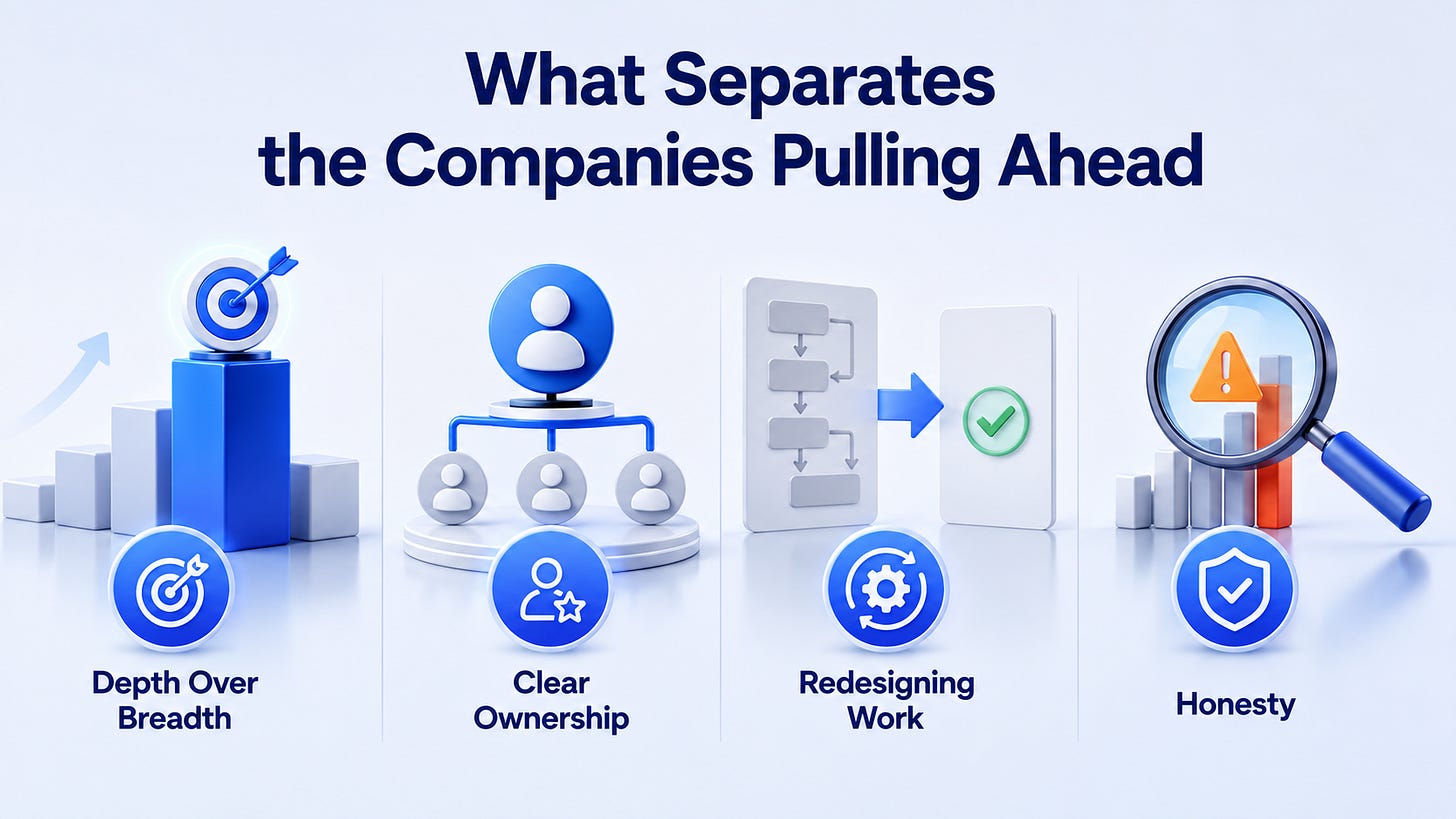
Depth Over Breadth
Leading companies tend to focus on a small number of high-value problems and go deep. This looks less impressive on a slide than “AI across every department,” but it’s the pattern among companies that actually convert AI into results.
Clear Ownership
Ownership is another dividing line. Companies pulling ahead usually have AI decisions assigned to a clear owner. Someone is accountable for outcomes. That single difference predicts almost everything else, including better governance, faster course correction, and less duplicated spending across departments.
Redesigning Work
The companies further along also treat AI transformation as a fundamental redesign of how work happens. Their question is not how AI can shave a few steps off a workflow. They ask whether the workflow should exist in its current form at all. That’s a harder, slower conversation, which is why most companies avoid it and settle for incremental automation.
Honesty
Leading companies also tend to be candid about what isn’t working. They are comfortable naming underperforming pilots and killing projects that don’t justify their budget.
The Fortune 500 AI-Native Endgame
There’s no single finish line here. There is no moment when a company can declare itself officially “AI-native” and stop paying attention. The companies furthest along already understand this. They are building the muscle to keep adjusting as the technology and their competitors continue to move.
The end goal is less about the AI itself and more about changing how the organization operates. Decisions happen faster because people have better information at their fingertips.
Teams spend less time on repetitive tasks and more time handling decisions that truly require human judgment. Governance also becomes part of the day-to-day system rather than something added later as a compliance exercise.
The companies that get there first will be those willing to rethink how the business operates. For everyone else, the danger is mistaking a lot of AI activity for real transformation and realizing the difference too late.
Bottom Line
The journey to becoming AI-native has no final destination. It’s a different way of running the company. The Fortune 500 firms pulling ahead treated it that way from the start. They focus on fewer, more targeted pilots with clearer ownership and a willingness to redesign work. Overall, the real advantage will belong to those who make AI part of how the enterprise continues to operate, adapt, and compete.