Venture capital followed a predictable path for decades. A startup raised a pre-seed round and secured a larger seed investment. Afterward, it graduated to Series A and, if growth continued, climbed through Series B, C, and beyond before reaching an IPO or acquisition. Every stage had its own investors, each playing a distinct role in helping young companies mature.
That ladder is starting to look very different now. In February 2026 alone, 83% of the $189 billion invested globally in venture capital went to just three companies (OpenAI, Waymo, and Anthropic). The rest of the thousands of startups and hundreds of funds split what was left.
The venture market now has two extremes, with almost nothing holding up the middle. On one end, investors are writing small checks to ambitious founders before a product even exists. On the other, firms are deploying billions into companies that have already proven market leadership and now need capital to scale AI infrastructure or global operations. In between, the mid-sized funds that used to be venture’s default are disappearing.
This is the barbell strategy, a concept borrowed from portfolio management, where investors avoid the middle and concentrate at the two opposite ends of the risk spectrum.
Higher interest rates, longer exit timelines, AI-driven shifts in startup economics, and an unprecedented concentration of capital are shaping how venture firms deploy capital. This guide explores why venture capital is becoming polarized and what this shift means for founders and investors navigating the next era of startup funding.
The Data Behind the Squeeze
Nobody had to wait long for the numbers to catch up to the theory. The first half of 2026 delivered them early.
North American startups raised a combined $392 billion in the first half of 2026, surpassing every previous full-year total on record. Yet seed funding moved in the opposite direction. Investment in seed and angel rounds fell 27% year over year in the second quarter, as the largest rounds continued to flow into late-stage AI companies.
Let’s look at global half-year totals. Global venture funding reached a record $510 billion in the first half of 2026, surpassing the $440 billion invested in all of 2025. OpenAI and Anthropic alone accounted for $217 billion of that (43% of every dollar raised globally). So nearly half the world’s venture capital went to two companies.
Another important point is that deal volume is shrinking while dollar volume is surging. Reach Capital’s early-stage fundraising report found that Q1 2026 saw fewer than 4,000 deals, down from over 5,000 in the same period last year.
Fewer companies are getting funded. The ones that do are getting funded at a scale nobody has seen before. That combination of fewer deals and bigger checks hollows out a middle that depends on volume and moderate check sizes to build a diversified portfolio.
Venture capital is not simply growing or shrinking. It is becoming more uneven. A larger share of the industry’s total capital is concentrating in fewer companies, while the number of startups competing for the remaining capital is increasing.
That is the data behind the squeeze. The next question is what is causing it.
Why Venture Became a Barbell
The barbell isn’t the result of a single sudden shift in investor behavior. Several forces have made both ends of venture capital more attractive.

The Cost of Waiting Has Gone Up
Higher interest rates and slower exits have changed the math of venture investing. When capital is expensive and investors may have to wait longer for liquidity, a promising startup is less attractive than it once was.
Investors want either maximum ownership at the earliest possible stage or sufficient evidence that a company has already distinguished itself from the pack. The middle ground offers less obvious upside, as it is where a startup has a high valuation yet still faces years of execution risk.
AI Has Made Both Ends More Attractive
AI is accelerating the split by reducing costs for some startups and making others extraordinarily capital-intensive.
A small team can now use AI tools to build and launch products for far less money than earlier generations of startups required. That makes early bets more attractive, as a small investment can take a company much further than it could a few years ago.
At the other end, the companies building frontier models and the infrastructure to support them require billions. In Q1 2026, $235 billion of the $300 billion invested globally went to 158 late-stage companies raising at least $100 million in funding rounds.
Therefore, the same technology is pulling capital in opposite directions. Smaller checks can fund more ambitious startups, while the biggest AI companies need industrial-scale financing.
LPs Want Fewer, Clearer Bets
Limited partners have also become more selective about where they deploy capital. After the funding boom and subsequent slowdown, raising another mid-sized fund is no longer sufficient. Investors need a clear reason to choose one manager over the hundreds of alternatives.
That pressure favors specialist early-stage funds with a genuine sourcing edge and large funds capable of participating in the biggest opportunities.
The result is a market focused on two forms of conviction. First is backing a company before the outcome is visible. Second is investing heavily once the winner appears to be too important to ignore.
The traditional middle has not disappeared. But it now has to compete with both ends of the market and explain why it offers something neither can.
Why Investors Still Love Pre-Seed
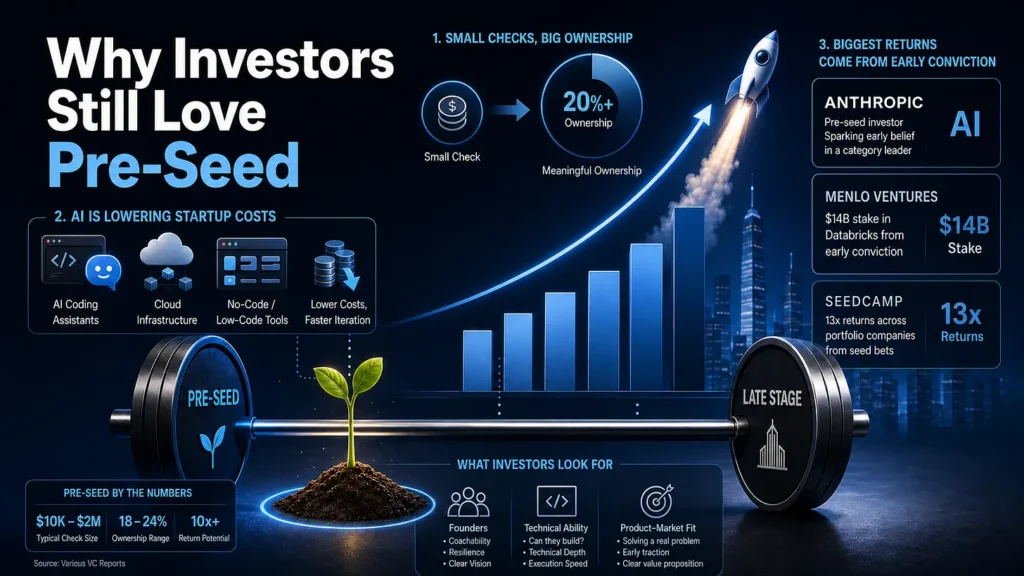
The left side of the barbell is very much alive. Pre-seed investing gives venture firms the chance to get in early and secure some ownership. It also lets them get involved in shaping a company before the market decides its value.
Small Checks Can Buy Substantial Ownership
A pre-seed investor may invest hundreds of thousands of dollars or a few million when a company is valued far below what it might reach after finding product-market fit. That creates a different risk-reward equation from investing in a later-stage startup after several rounds of dilution and valuation increases.
The bet is not necessarily on a finished product. It is on the founder’s ability to turn an insight into one. That is why early-stage investors spend as much time evaluating founders as they do products. Technical ability, speed of execution, customer insight, and the ability to attract talent can matter more than current revenue when there is barely a business to measure.
AI Has Lowered the Cost of Getting Started
The economics of building a startup have also shifted. AI coding assistants, cloud infrastructure, no-code tools, and capable foundation models enable small teams to build and test products faster than earlier generations. That makes pre-seed capital more powerful.
A founder who once needed a large engineering team to build a prototype may now be able to launch an initial version with a much smaller team. As a result, investors’ money can fund more experiments and product development before the company needs to raise its next round.
The Biggest Returns Still Come From Early Conviction
The potential upside is what keeps investors competing for the earliest deals. A small investment made before a startup becomes obvious can secure more ownership than the same amount invested after several funding rounds.
Anthropic shows why. Menlo Ventures backed the company before it launched a product and continued investing as it scaled. Its stake is now estimated at around $14 billion and helped drive the firm’s $3 billion fundraise in 2026.
The pattern extends beyond AI. European early-stage investor Seedcamp says its third fund has returned more than 13x the capital distributed to limited partners, having backed companies such as Revolut, Wise, and UiPath early in their journeys.
These are extreme outcomes, which aren’t common in pre-seed returns. However, venture portfolios are built around finding the rare companies capable of returning an entire fund. The earlier an investor identifies one, the more powerful that investment can become.
Why Mega Funds Keep Getting Bigger
At the other end of the barbell, scale is becoming self-reinforcing. A fund with billions of dollars to deploy cannot build a solid portfolio by writing only $2 million checks. The math pushes it toward larger rounds and larger positions for companies capable of absorbing enormous amounts of capital.

The Size of the Fund Changes the Deals It Needs
Five years ago, a billion-dollar venture fund was considered enormous. Today, that sum can be deployed in a single financing round. The shift is evident in AI, where the cost of compute, data centers, chips, and talent has turned some startups into infrastructure-scale businesses.
The result is a structural shift in who controls venture capital. As funds grow larger, they need larger investments to deploy their capital efficiently. This concentrates more money in the hands of the biggest managers. Wellington Management found that the top five venture managers captured 73.1% of all venture commitments in Q1 2026, while the top 15 captured 88.5%. The bigger the fund, the fewer deals it needs.
Bigger Funds Are Making Fewer, Larger Bets
Firms known for writing many early-stage checks are becoming more selective. Andreessen Horowitz made more than 300 seed and Series A investments in 2024 and 2025, but completed only 74 such deals in the first half of 2026, according to PitchBook data reported by CNBC.
That shift captures the broader change in the shape of fewer investments, larger checks, and greater concentration on companies that can absorb substantial capital.
Sovereign Capital Is Raising the Ceiling
The dominance of traditional venture firms at the top of the market has now shattered. Abu Dhabi-backed MGX closed its first fund at $49 billion, exceeding its original $45 billion target, and has invested in AI companies, semiconductors, and infrastructure. It has also backed companies including OpenAI and Anthropic.
A $500 million mid-market fund cannot compete with that level of capital in a billion-dollar growth round. That is why mega-funds keep getting bigger. The market rewards investors capable of financing companies at the scale that the most important opportunities now demand.
Why the Middle Is Being Squeezed
The problem with the mid-sized funds is that their economics are becoming difficult to make work.
The Fund Math Is Getting Harder
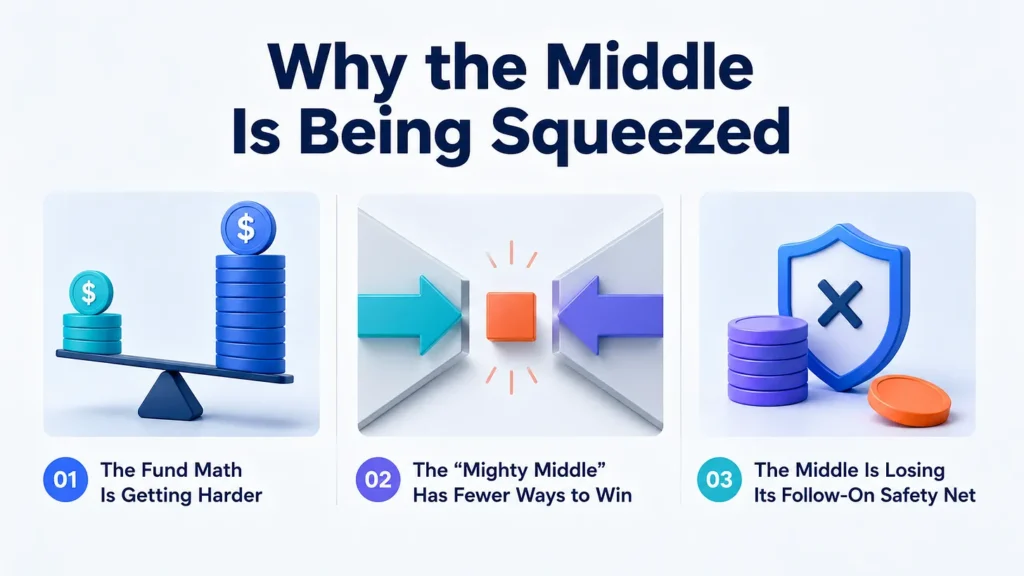
The problem becomes clearer when you compare two funds. Imagine a $50 million fund and a $500 million fund both investing $1 million in the same startup. If that startup eventually turns the investment into $100 million, the win has a different impact on each portfolio.
For the $50 million fund, that single investment has generated twice the value of the entire original fund. For the $500 million fund, the same $100 million exit remains an excellent result, but it represents a much smaller share of the portfolio.
That is the math behind the squeeze. As funds grow larger, they need more and bigger winners to generate strong returns. A mega-fund can no longer rely on one or two small early-stage investments to transform its performance. It needs companies that can absorb substantial capital and deliver exits at a scale that moves the needle.
The “Mighty Middle” Has Fewer Ways to Win
This is where the market’s middle begins to feel pressure. Venture capital is increasingly divided between enormous funds capable of competing for mega-deals and focused smaller investors who can move early and specialize. Mike Smeed of InMotion Ventures described the middle as a “danger zone” because it is neither large enough to compete for the biggest rounds nor specialized enough to dominate early-stage investing. His response was to move further down the stack into seed and Series A, where specialization and discipline still offer an advantage.
The deal flow reflects the shift. An $800 million Series C for AI infrastructure can attract the largest funds, while smaller specialist rounds continue to find investors. What has become harder to fund is the middle ground, such as a solid but unspectacular company raising $40 million to $80 million in a Series B.
Those companies have not disappeared. The capital willing to lead their rounds has become harder to find.
The Middle Is Losing Its Follow-On Safety Net
Corporate venture capital is becoming more selective, too. Silicon Valley Bank’s State of CVC research found that the share of corporate funds using secondary markets to exit positions increased from 15% in 2024 to 22% in 2025. As corporate investors reduce exposure or wind down programs, startups risk losing a strategic backer and an expected source of follow-on capital.
So, the middle is being squeezed from both directions. The biggest funds are becoming more powerful, and smaller investors are moving earlier and becoming more specialized. Being “in between” is no longer a strategy for a mid-market fund without a clear advantage.
How to Survive the New Venture Capital Market
The barbell market changes the fundraising playbook for everyone. Founders can no longer assume that raising a larger round is automatically the next step. Similarly, investors need to decide whether they want to compete on scale or specialization.
For Founders:
- Raise enough capital to reach the next crucial milestone, not to announce a larger funding round.
- Bring evidence of paying customers and of demand/retention instead of relying solely on growth projections.
- Choose specialized investors who can provide relevant expertise and connections.
- Align your funding strategy with your capital needs, whether that means staying lean or preparing for infrastructure-scale investment.
For Investors:
- Compete on scale for mega-deals or on speed/access/specialization at the earliest stages.
- Match fund size to strategy instead of growing to manage more capital.
- Build a genuine sourcing or sector advantage that larger competitors cannot replicate.
- Accept that being a generalist mid-market fund is becoming harder to differentiate.
Bottom Line
Venture capital has reorganized. $510 billion moved through the global market in just six months, yet deal counts kept falling, and 43% of that total went to two companies. That’s not a temporary distortion waiting for the AI hype cycle to cool. It’s a structural reshaping of where capital can profitably sit, i.e., tiny, disciplined checks at the very beginning, enormous platform-scale checks at the very end, and a shrinking amount of room in between. Anyone raising or deploying capital in the next few years needs to pick an end of the bar because the middle isn’t holding anyone up anymore.