Pitching a VC on autonomous drone swarms in 2023 would have gotten you a polite pass. Orbital manufacturing? “Interesting, but not for us.” Another cybersecurity dashboard? Good luck, but the market felt tapped out.
Defense was unattractive to LPs with ethics mandates. The space was still nursing its SPAC hangover. Cybersecurity looked saturated, with dozens of point solutions competing for attention in a crowded market.
Fast-forward to today, and those same three “no thanks” categories are the sectors venture capital can’t stop pouring money into. Anduril raised at a $30.5 billion valuation in 2025 and now at $61 billion in 2026. SpaceX has a record $75 billion IPO at $135 a share. Google paid $32 billion for a cybersecurity startup most people had never heard of two years ago. What happened?
This isn’t a hype story. It’s what happens when geopolitical shock, a jump in AI capability, and a decade of underinvestment collide. They have turned these three “boring” or “uninvestable” sectors into the backbone of 2026’s venture market.
Let’s explore what has actually changed, backed by the numbers, and why it matters well beyond the term sheets.
Defense Tech Is Officially Mainstream Now
What was once specialized military kit now shapes mainstream tech conversations. This category went from off-limits to oversubscribed in the span of two funding cycles. Let’s find out how that shift actually played out, deal by deal.
The Six-Year Climb
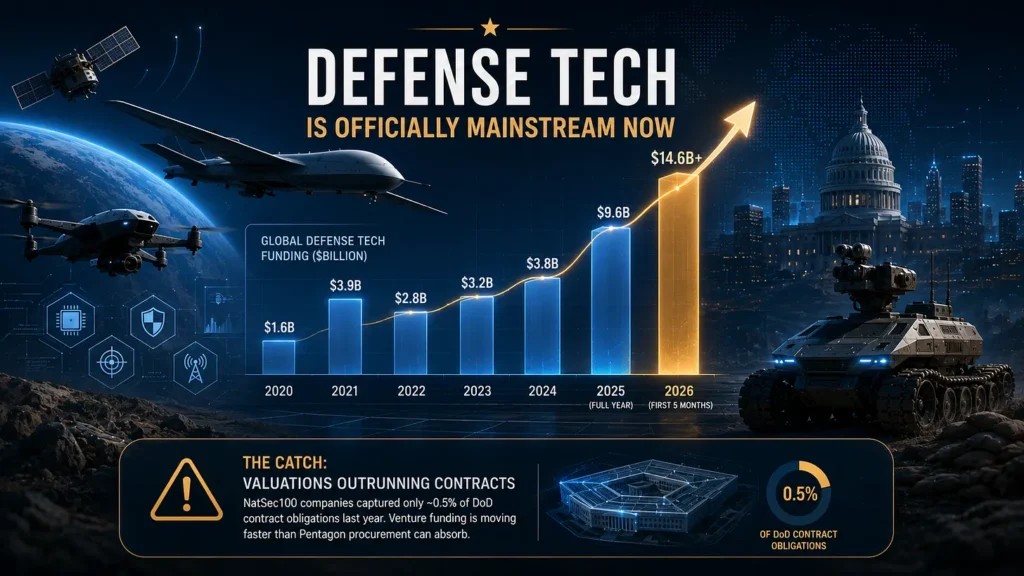
Global defense tech funding stood at about $1.6 billion in 2020, rose to $3.9 billion in 2021, and then plateaued between $2.8 billion and $3.8 billion annually from 2022 through 2024. During that period, most generalist VCs still treated the sector as a niche for specialists with security clearances and government contacts.
Then 2025 broke the pattern entirely. Funding jumped to a record $9.6 billion for the year. By late spring 2026, startups in the military, national security, and law enforcement sectors had already surpassed that annual record, pulling in more than $14.6 billion in just five months.
Anduril and the Proof-of-Concept Round
The clearest proof point is Anduril Industries. Founded in 2017 by Palmer Luckey and a few Palantir and Oculus alumni, the autonomous-systems maker closed a $2.5 billion Series G in June 2025, valuing the company at $30.5 billion.
In less than a year, the company raised another $5 billion in Series H in May 2026, pushing its valuation to $61 billion. According to reporting cited by the Financial Times, Anduril’s 2025 revenue reached $2.2 billion, giving the round an unusually credible revenue base for a defense startup of its age. Thrive Capital and Andreessen Horowitz led that round. They are not specialist defense funds but two of Silicon Valley’s most mainstream growth investors. This signals that defense has crossed into generalist territory.
The Rest of the Field
Anduril isn’t carrying the sector alone. Shield AI, which builds autonomy software for aircraft operating without GPS or reliable communications, raised a $2 billion Series G in March 2026, led by Advent International and JPMorgan Chase. Saronic, which manufactures unmanned surface vessels for naval use, closed a $1.75 billion Series D the same month, led by Kleiner Perkins.
Space-adjacent defense players, such as True Anomaly, Sierra Space, and Vast, also rank among the year’s top recipients. This reflects how blurred the line between “defense tech” and “spacetech” has become.
Fewer Deals, Bigger Checks
What’s notable is that deal count hasn’t grown as quickly as dollar volume. Crunchbase tracked about 107 defense-related venture rounds through the first several months of 2026, only modestly ahead of 2025’s pace of 206 total deals. This suggests capital is concentrating in fewer, larger checks rather than spreading across a broader founder base.
The Catch: Valuations Are Outrunning Contracts
There’s a healthy dose of caution embedded in the boom, too. Axios, reporting on Silicon Valley Defense Group data, found that NatSec100 companies (the cohort of venture-backed defense startups tracked for national security relevance) captured only about 0.5% of Department of Defense contract obligations last year.
In other words, venture funding is moving faster than Pentagon procurement can absorb it. That gap between private valuations and durable government revenue is the sector’s central tension heading into the second half of 2026.
Spacetech’s Quiet Climb to a Trillion-Dollar Question
Space tech’s 2026 story isn’t about one headline-grabbing number from SpaceX. It is about momentum that keeps compounding across launches, satellites, and orbital infrastructure, quarter after quarter.
The Numbers Behind the Momentum
Crunchbase-tracked space and satellite funding hit a full-year high of over $12 billion in 2025, and the sector opened 2026 with more than $2 billion in reported investment in just the first stretch of the year, with megarounds “stacking up” month over month.
Tracxn’s independent count found space tech companies raised $3.71 billion across 44 rounds through April 2026, a 152% jump over the same period in 2025 (Tracxn).
The Deals Driving the Surge
The individual deals illustrate the why.
Stoke Space, a Washington-based developer of fully reusable rockets, extended its Series D to a total of $860 million.
Houston’s Axiom Space, building a commercial successor to the International Space Station, closed $350 million in February.
Sierra Space, building satellites, spacecraft, and space subsystems, raised $550 million at an $8 billion valuation in a round led by LuminArx Capital Management.
Satellite-bus maker Apex Space and next-gen satellite operator Astranis each closed rounds of north of $200 million.
Europe Joins the Race
Europe is no longer watching from the sidelines. ICEYE, a Finnish-founded, Finland-headquartered radar-imaging company, reached a €10 billion valuation after a Series F round exceeding €1 billion.
Similarly, German launch startup Isar Aerospace closed a €270 million Series D round. All this is evidence that the capital-intensity threshold for credible space ventures has risen on both sides of the Atlantic (TFN).
SpaceX: The IPO That Changed the Investment Narrative
SpaceX is the company that convinced investors that commercial space could become a viable business. The top highlight in spacetech investment is its record-breaking IPO in June 2026, which became the largest public offering in history. It gave the company a valuation of $1.77 trillion.

The listing provided venture investors with a public-market benchmark. Launch providers and orbital infrastructure startups are no longer seen as speculative moonshots but as businesses with a proven path to venture-scale returns. The IPO also delivered a massive liquidity event for early backers, reinforcing investor confidence and fueling fresh capital across the broader spacetech ecosystem.
A Broader Investment Shaping Up
SpaceX remains the industry’s standard-bearer, but more than two dozen spacetech startups have also raised rounds exceeding $100 million in the past year. This level of activity would have seemed unrealistic just a few years ago.
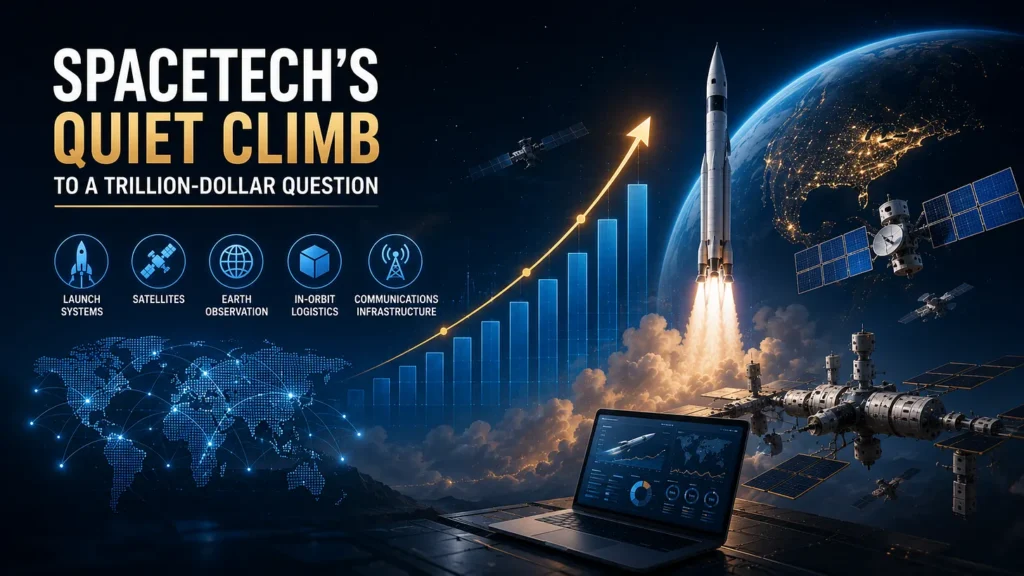
Investors’ portfolios now span reusable launch systems, satellite manufacturing, Earth observation, in-orbit logistics, and communications infrastructure. Investors are not specifically searching for “the next SpaceX.” They are building portfolios across the entire space value chain.
Why Space and Defense Are Becoming One Investment Theme
Another reason investors are pouring money into spacetech is the growing link between space and defense activities. Satellites now power secure military communications, intelligence gathering, missile tracking, battlefield navigation, and more. As a result, space infrastructure is becoming a strategic asset.
KPMG’s Q1 2026 Venture Pulse also grouped defense tech and spacetech together because both sectors continue to attract strong venture investment and benefit from growing government support.
Cybersecurity Sees Fewer Deals, Bigger Checks, and Record Exits
Cybersecurity never fell out of favor the way defense and space did temporarily. However, 2025 and 2026 have influenced what well-funded means in the category.

A Record Year for Fresh Capital
Cybersecurity startups raised $18 billion in seed-through-growth rounds in 2025 alone. That was up 26% year-over-year and the strongest showing in three years, according to Waveup’s fund-tracking data. Israel, historically a disproportionate contributor to cyber talent through Unit 8200 alumni networks, captured $4.4 billion of that total on its own, up from $4 billion the prior year.
The Exits That Changed Everything
Recent exits have reshaped the sector’s psychology. Google’s March 2025 acquisition of cloud-security unicorn Wiz for a reported $32 billion is the largest cybersecurity acquisition on record. Palo Alto Networks’ $25 billion purchase of identity-security firm CyberArk followed shortly after.
Both acquisitions represent about $57 billion in strategic capital, validating that top-tier private cybersecurity assets can command public-market-level multiples. Those two acquisitions changed how growth investors view cybersecurity. They no longer consider it another enterprise software category. They now see it as critical infrastructure with strategic value to the world’s largest technology companies.
AI Reshapes the 2026 Product Roadmap
If 2025 was about investors betting on cybersecurity, 2026 is about AI redefining what cybersecurity companies build. Crunchbase found that a majority of cybersecurity-related funding in Q1 2026 went to companies also classified under its AI categories. This reflects how deeply AI has become embedded in the industry.
The focus is now moving beyond detecting threats faster. Companies are also building tools to secure AI models, protect against prompt injection, defend training data, and automate security operations.
The funding activity reflects that shift:
- Cloaked raised in Series B funding to expand its consumer privacy platform.
- Tenex.AI secured a $250 million Series B to develop AI-powered cybersecurity solutions.
- Upwind Security also closed a $250 million Series B to strengthen cloud-native security.
The consolidation trend is also evident. Companies are not building every AI capability in-house. Large vendors are acquiring innovation:
CrowdStrike acquired identity security startup SGNL for approximately $740 million.
Palo Alto Networks followed by acquiring AI-driven endpoint security startup Koi for around $400 million.
These deals show that AI has become a feature in cybersecurity products and a foundation of the industry’s next generation of platforms. It will also be a key driver of venture investment and acquisition activity.
The Small Round Punching Above Its Weight
Cybersecurity’s biggest story isn’t always written by the largest checks. Some of the strongest signals are coming from smaller funding rounds backing startups with specialized technologies.
Take Vigilance Security, an AI-native threat intelligence startup founded by two former members of Israel’s elite Unit 81 intelligence unit. The company raised just $5 million in a Sequoia Scout-led seed round and reached a revenue run rate of nearly $3 million. This is an unusually high level of capital efficiency for such an early-stage cybersecurity company.
In a market where many startups rely on ever-larger funding rounds to fuel growth, Vigilance demonstrates that strong product-market fit and disciplined execution can outperform sheer fundraising power.
It’s also a useful reminder that cybersecurity’s future won’t be defined only by billion-dollar rounds. Some of the sector’s most interesting bets are still happening at the earliest stage, on the strength of product-market fit.
The New Playbook for Venture Capital
There is a common thread that emerges when we look across defense, spacetech, and cybersecurity. These sectors are being reshaped by three powerful forces that are changing how venture capital evaluates long-term opportunities:
- Geopolitical instability: The Russia-Ukraine war, renewed conflict in the Middle East, and escalating U.S.-China tensions have made national resilience a spending priority.
- AI reaching commercial maturity: Advances in autonomy and cyber defense, along with satellite intelligence, have transformed AI from a promising technology into a deployable competitive advantage.
- Years of underinvestment: A decade of limited funding in capital-intensive industries created space for startups to challenge slower-moving incumbents, including Lockheed Martin, Boeing, and legacy cybersecurity vendors.
That doesn’t mean the boom is risk-free. Defense startups still need to convert valuations into long-term government contracts. Spacetech remains capital-intensive, and cybersecurity’s billion-dollar funding rounds raise valid questions about pricing and sustainability.
This cycle looks different from the consumer app and crypto booms that came before it. The demand is supported by expanding government budgets and persistent geopolitical tensions.
The message for VCs is: the next decade’s big returns may come from startups developing technologies that strengthen national security, protect digital infrastructure, and expand the commercial space economy.