
Most founders treat scaling like a finish line. Their assumption of winning is tied to sprinting toward more users and more markets sooner. The data says the opposite.
Startup Genome’s analysis of more than 3,200 high-growth tech companies found that 74% failed because they scaled prematurely. They expanded before they had proven the business worked, so none of them reached the 100,000-user mark. And those startups that scaled at the right pace grew about 20 times faster than those that rushed.
The irony is that the fastest way to grow big is rarely to start big. It’s to dominate something small first, build proof and momentum there, and only after that expand outward with evidence. So don’t think of niching down before scaling as a compromise successful founders settle for. It’s the strategy the most durable companies chose, and you should focus on how to apply it to your own startup.
What “Niche First” Actually Means
Niching down isn’t about playing small or lacking ambition. It’s a deliberate strategic choice, known in startup circles as finding your beachhead market. It is a term MIT’s Bill Aulet borrowed the term from military history, where Allied forces secured a small foothold on the Normandy coast before advancing inland. The same logic applies to a startup. Pick one winnable segment, dominate it completely, and use that position of strength to expand into adjacent markets.
This is different from having a target customer. A beachhead market needs to meet a few specific conditions:
- The customers in it buy in similar ways.
- They talk to each other, so word of mouth can spread.
- The segment is small enough that a startup with limited resources can become the obvious choice within it.
Geoffrey Moore made a similar case decades earlier in “Crossing the Chasm“. He argued that trying to appeal to a broad market before establishing a beachhead is exactly what causes promising products to stall before they reach the mainstream.
The mistake most founders make is underestimating how narrow “narrow” needs to be. A target market labeled “small businesses” or “remote teams” usually isn’t a beachhead at all. It’s still a broad market wearing a disguise.

A real beachhead is specific enough that you could list the first fifty companies or people who belong in it by name. For example, “small businesses” lumps together a dentist’s office, a law firm, and a food truck. These groups have nothing in common. A real beachhead is narrow enough to name, like “solo hairstylists who book by text,” which makes your messaging, pricing, and hiring easier to get right.
Why Going Broad Too Early Backfires
There is no denying that a big market is appealing. More potential customers would mean more potential revenue. However, it’s usually the opposite in practice. When a startup tries to serve everyone from day one:
- Its messaging becomes vague.
- Its product roadmap is pulled in conflicting directions.
- Its limited marketing budget gets stretched so thin that no single audience ever notices it.
Webvan is a great example of this point. During the dot-com era, the online grocery startup built out a massive warehouse and delivery infrastructure to serve a sprawling national market before it had proven the model worked in even one city. As a result, it collapsed under the weight of that premature expansion.

Quibi ran into a similar wall decades later. The short-form video platform tried to win over “on-the-go” viewers on a broad scale. It didn’t first identify a specific underserved audience, and it struggled because people already had strong alternatives for short-form and streaming video.

Startup Genome research also found that startups showing signs of premature scaling were 2.3 times more likely to overspend on customer acquisition before confirming product-market fit. For example, Segway was marketed too broadly as a mass-market device rather than proving demand with a specific early user group (such as warehouse workers or tour operators). That lack of focus contributed to its failure. Going broad prolonged the mistake rather than reducing risk

The Companies That Got Famous by Starting Small
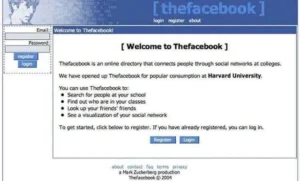
We have plenty of examples of today’s largest companies showing that a small initial market can be a key growth strategy. Facebook is a perfect example. The platform launched exclusively for Harvard students in February 2004 and required a Harvard.edu email address to create an account. Within a month, more than half of Harvard’s undergraduates had signed up. Only after that single campus was won did the platform expand to other Ivy League schools, then colleges, then high schools, and eventually the public.
Slack followed a similar script on the B2B side. The founders didn’t try to sell collaboration software to every business. They focused on tech companies that were already comfortable trying new software and had a painful need for better team communication. That early audience gave Slack a strong foothold and helped it spread to similar companies through word of mouth.
The following are a few other examples of companies getting famous by starting small:
- Airbnb started as a niche brand before becoming a global brand. The founders first rented air mattresses in their San Francisco apartment to host design conference attendees when hotels sold out, then focused on event travelers before expanding into everyday travel.
- Uber launched in 2010 as UberCab, a premium black-car service in San Francisco for tech professionals seeking a reliable ride, and later expanded into mass-market ride-hailing.
- LinkedIn launched in 2003 for working professionals who wanted to manage their careers and networks, not for general social networking.
- Tinder first gained traction on college campuses, including USC, where targeted promotion helped create the user density needed for matches.
- Spotify began in Sweden, where it built label relationships and proved the streaming model before expanding outward.
- Etsy launched in 2005 around independent handmade-goods sellers, which helped it build a focused community before it broadened its marketplace.
How to Identify Your Own Beachhead
The right starting niche requires meeting a few testable criteria. Founders trying to impress investors with a massive TAM slide often choose the wrong starting point by picking a segment for its size rather than its winnability. The right beachhead comes down to four checks:
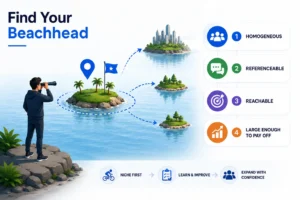
It Should Be Homogeneous
Most customers in the segment should share similar needs and buying behavior, so you are not running multiple sales pitches at once. A market with several distinct buyer types forces you to split your focus before you have even won one of them.
It Should Be Referenceable
Customers within the segment should talk to each other. They can connect through a tight-knit industry, a shared online community, or a physical space (like a conference). That density means one happy customer brings in more customers without extra effort from you.
It Should Be Reachable
You need to be able to realistically find and contact this audience without an enormous budget. A niche that’s perfect in theory but invisible or expensive to reach isn’t a real beachhead.
It Should Be Large Enough to Pay Off
The segment needs to be large enough to validate the business model and fund the next phase of growth, even if it’s only a small slice of your eventual total market. Beachheads represent just a sliver of the total addressable market a startup eventually hopes to capture.
An MIT case study is a valid example here. A sunscreen startup first aimed at the mass market but got traction only after focusing on triathletes in their thirties. That niche had the buying power, motivation, and community to adopt the product quickly. After the team learned what worked, expanding into the broader market became easier.
How to Know You’re Ready to Expand
Niching down only works as a growth strategy if you eventually scale beyond it. The goal isn’t to stay at a beachhead forever. It is just the launchpad. The signal that you are ready usually comes from two things happening at once:
- Your win rate within the niche is consistently strong, typically cited as above 30%. This shows that you are not just winning occasionally by luck.
- You are starting to see inbound interest from adjacent segments without actively pursuing them. This second signal is crucial for founders because it indicates the market is pulling you toward expansion.
Let’s take Tesla as an example to understand its pacing strategy. The company sold only 2,450 units of its original Roadster. It was a deliberately small, expensive niche product aimed at wealthy early adopters who cared about performance and sustainability. That narrow beachhead let Tesla prove that electric vehicles could be desirable. It also helped the company gather data before expanding step by step into the broader, more price-sensitive mass market it serves today.

Each new model targeted a wider segment than the last. So it is important to understand how patient that sequencing actually was. Years separated each expansion, which runs directly against the instinct most founders have to widen their market the moment early traction looks promising.
Building the Discipline to Stay Narrow
The hardest part of the niche-first, scale-later strategy is maintaining discipline to stay within the niche when it feels uncomfortably small. Investors may pressure founders to demonstrate a larger total addressable market before the business is ready, while competitors expanding into adjacent markets can trigger a fear of missing out. It’s easy to mistake looking bigger for becoming stronger.
Resisting that pressure is what separates startups that scale on a solid foundation from those that scale on hope. The pressure to appear large and the need to actually win are two very different challenges. Confusing the two leads founders to premature expansion and dilutes the focus that made the business successful in the first place.
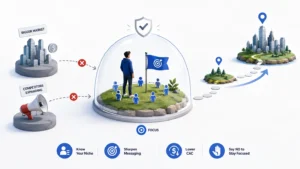
A simple way to test whether your niche is well-defined is to ask whether you can describe your ideal customer in a single sentence. “Marketing teams” isn’t a beachhead. “Marketing managers at 20-to-50-person SaaS companies who currently track campaigns in spreadsheets” is much closer. The more specific the description, the easier growth decisions become. Your messaging gets sharper, and your acquisition channels get cheaper. Plus, your product roadmap stops trying to please everyone at once.
A narrow focus also makes it easier to say NO. For example, declining a tempting customer outside your target niche or postponing a feature request that serves only a small outlier helps protect the momentum you are building. Simply put, focus is a competitive advantage in the early stages of a startup, giving you the best chance to dominate one market before expanding into the next.
The Bottom Line
The founders of the biggest companies rarely start by chasing the biggest market. Facebook started with one university. Amazon started as an online bookstore. Tesla started with 2,450 cars. Slack started with tech companies trying out new tools. In each case, the narrow starting point was what made that ambition achievable.
Given that 3 out of 4 high-growth startups fail because they scale before they are ready, the founders who should get attention aren’t the ones expanding the fastest. They are the ones willing to stay small and specific long enough to earn the right to grow.
Do the test yourself. If your current target market is still so broad that you can’t name the first 50 customers, start narrowing it down instead of pushing ahead with a bigger campaign. Start with a niche and scale only once you have actually earned it. That’s how startups build something built to last.